
Capping of the Ring highlighted in Lee Kuan Yee Work City Prize Publication
Publication
The Ring is a six-lane highway circling Antwerp and linking the Port, inner city neighborhoods, the Flemish hinterland, and Europe’s wider road network. As one of the continent’s most heavily trafficked urban arteries, The Ring funnels an average 300,000 vehicles daily.
For decades, it has etched a car-first logic into the local landscape, prioritizing cars and roads over people and public life. Clogged with traffic, thrumming with noise and fumes, and cutting through neighborhoods, it separates citizens from green edges and locks in outdated mobility habits. Ideas to cover the Ring with green space have been in circulation since the late 1990s, but years of political gridlock and competing priorities stalled progress.


The Flemish government appointed ORG as Intendant in 2016. Responsible not only for overseeing the design vision and uniting hundreds of residents, politicians, engineers, and activists around a shared goal, our role also involves coordinating complex negotiations, upholding agreements, and ensuring quality throughout planning and implementation.
The ambition is set to transform the divisive Ring Road into a ‘capped’ infrastructure that lets life flow once more. Sections of highway will be softened by public spaces, multimodal transit points, and green corridors that reconnect the city, the suburbs, and the surrounding nature.

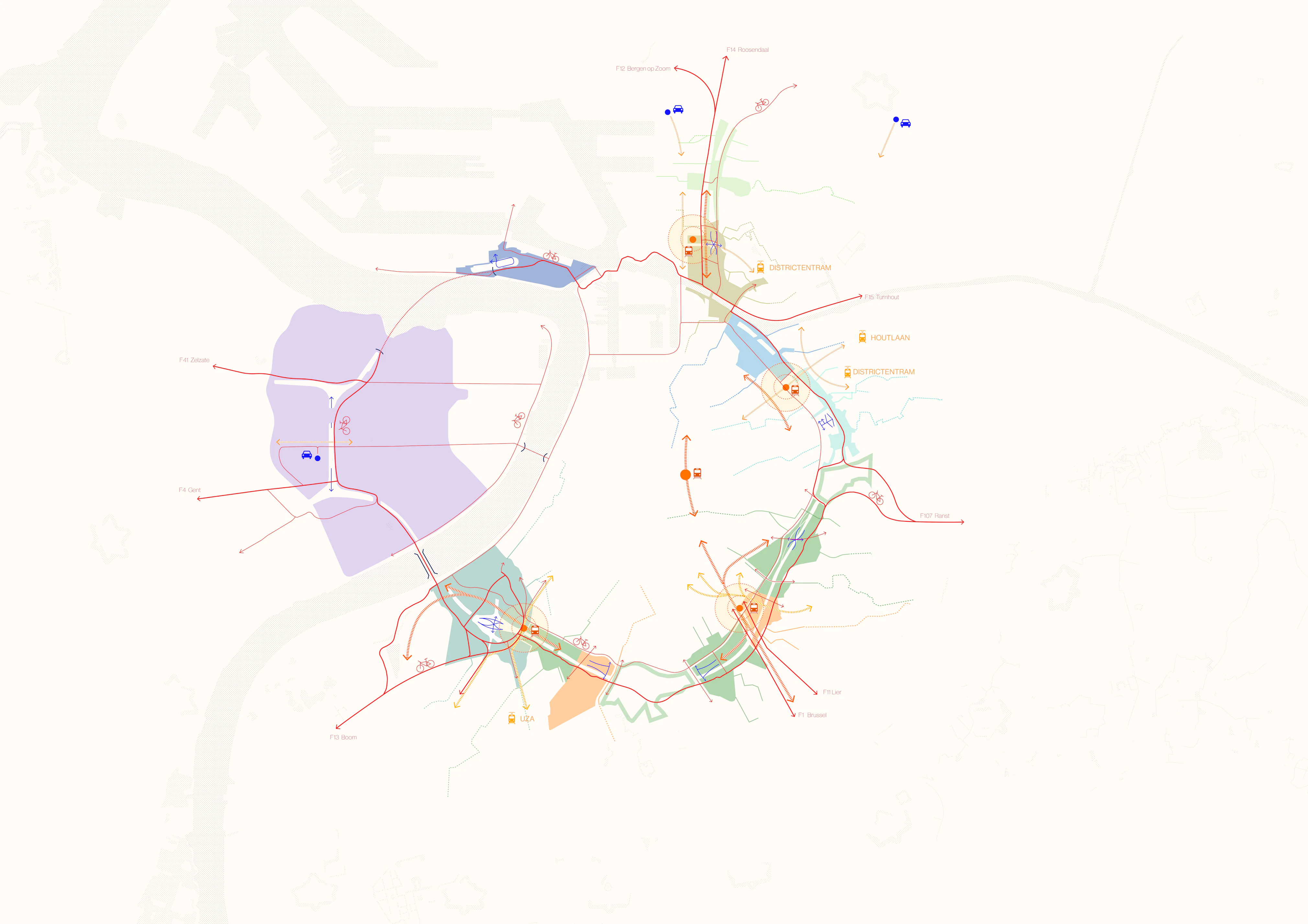


From the outset, we approached The Ring as a systemic knot in which mobility, urban structures and ecology had become entangled. With the project stretching across layers of policy, governance and design, we could only turn our vision into a reality by integrating spatial expertise, political awareness and cultural understanding. The project unfolded across two overlapping phases underpinned by a set of highly flexible tools and collaborative frameworks.
In Phase 1, we initiated a citywide co-creation process bringing together open forums, residents, experts, and public agencies to articulate a shared ambition for the Ring’s transformation. The public sessions were complemented by a series of technical studies covering mobility, ecology, health, and spatial connectivity. The vision started to take shape and finally led to the Covenant for the Future (Toekomstverbond). This 2017 agreement between the Flemish government, City of Antwerp and citizen groups broke a decade of stalemate and unlocked €1.25 billion in initial funding.

To transform this shared vision into a living reality, we then launched Phase 2 over 2018-2019. This involved an international design competition, with six multidisciplinary teams drafting proposals for Ring segments. Each team engaged with ORG's co-creation framework through collaborative workbenches, agile ‘scrum’ sessions, and expert ‘quality rooms’ that tested and refined proposals in local conditions.
Now in Phase 3 (since 2021), the selected designs for almost two thirds of the Ring have been detailed and are under construction until 2032. ORG's Team Intendant continues to monitor design quality, help repair partnership breakdowns, and figure out creative solutions when problems arise. Most importantly, we are deep at work to figure out the appropriate master design for the remaining sectors Antwerp’s highway system.
Under ORG's leadership, The Ring is being transformed into green spine linking neighborhoods with nature and people with public spaces. ‘Green nerves’ form the heart of this strategy: a series of densely programmed zones clustering public amenities, cultural programming and green space at key locations. Major train stations are being reimagined as multimodal hubs, enabling the seamless transfers between bikes, buses, trains, and foot. The aim? To prioritize sustainable transport and reduce the outdated dependency on vehicules.

Between these hubs, tailored ‘caps’ operate as urban seams stitching together fragmented neighborhoods, restoring ecological flows, and creating opportunities for recreation, noise buffering, and climate resilience. Each cap reflects its setting: some support parkland and play, while others focus on community, agriculture, habitat restoration, or port access.
The project has already started to improve the shape and feel of Antwerp’s infrastructure with several key projects underway. Construction has started on Pomppark Zuid, a 7.5-hectare green park reconnecting neighborhoods and expected to open by 2026. The green lungs of Merksemse Tuinen and Ringpark Het Schijn parks are progressing through the design phases toward construction. And preparations for Groenendaal Park and the extensive Cluster Centraal are set to shape large-scale green zones supporting ecological restoration and neighborhood connection.


The Investment Catalog aims to develop a comprehensive suite of infrastructure projects by qualifying potential candidates within a larger initiative. To do so, ORG composes a transformative large-scale vision, translates it into tangible project candidates, which are then developed through re-search and speed designs. These candidates are ranked and evaluated using a clear rubric, assessing public benefit, performance estimates, stakeholder support, and investment ranking. The projects are also analyzed through case studies, examining their interrelationships, performance, risks, and opportunities. The final Investment Catalog presents a cost and budget analysis along-side the ranked candidates, allowing stakeholders to make informed, confident decisions and reach a consensus on the most valuable projects for development.
In the context of the Capping of the Ring project, as realizing all the projects co-creatively designed by the multidisciplinary teams was not feasible within the Toekomstverbond’s budget (Future Covenant Agreement), ORG ran a multicriteria evaluation, leading to an Investement Catalog. Its first version is presented here.

The decision-making process is guided by two advanced planning tools.
The Solv stakeholder mode, born out of overall ORG experience, is also used in this project on a daily basis.


The Ring's transformation will enhance Antwerp as a livable, sustainable, mobility-rich city for future generations. As the project navigates its way around permits and politics, it is slowly but surely narrowing the gap between neighborhoods, systems, and people. And it is exciting to see how even the most complex urban challenge can become a laboratory for real-world innovation.


